
One year ago, President Donald Trump fundamentally reshaped global trade by imposing tariffs on nearly every country in the world. The initial tariffs along with the subsequent, frequent revisions to tariff rates and exemptions created a lot of confusion for companies, importers, and investors.
As the year progressed tariff uncertainty began to fade even though the trade policy was aggressive the pace of changes slowed and companies were able to adapt. By the end of 2025, the average effective tariff rate settled around 9.1%. Companies were able to pass on the increased costs to customers or absorb them as they reoriented their supply chains.
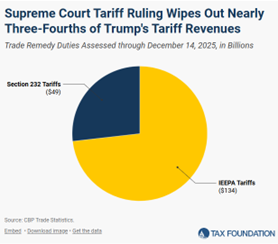
On February 20, 2026, the Supreme Court ruled against almost 75% of the implemented tariffs. Specifically, the Court ruled that the IEEPA reciprocal tariffs were not authorized under the law. However, the product specific tariffs under Section 232 were determined to be legal and remain in place. The Section 232 tariffs include rates as high as 50% on steel, aluminum, copper and as high as 25% on autos and auto parts and lumber products. The Court also stated there will likely be refunds issued but offered no guidance on the mechanism for refunding the amounts paid. Many companies have filed lawsuits to obtain refunds with the total amount refunded expected to be $166 billion. The administration has stated it expects a system to process the refund requests could be up and running in 45 days.
The legal setback did not put an end to tariffs and trade advisor Peter Navarro says the Courts ruling affirmed the use of every other statute. Almost immediately after the Supreme Court ruling against the tariffs, the President imposed a new 10% tariff across the board under a different statutory authority of the law. These new Section 122 tariffs can go as high as 15% and are only temporary expiring 150 days after implementation. If the Section 122 tariffs were to remain in place beyond expiration in late July Congress would need to approve any extensions. Unsurprisingly twenty-four states have since filed lawsuits challenging the Section 122 tariffs. The new lawsuit is largely expected to be put on a fast-tracked hearing similar to the previous tariff challenges.
Market reaction to the Court ruling was positive with the S&P 500 up nearly 1% and bond yields falling. Companies have learned to operate in the new paradigm and any improvement on the tariff front will flow directly to EPS. According to FactSet, the EPS growth is accelerating in 2026 and is estimated to grow 17.15% in 2026 vs the 13.13% we saw in 2025. If the EPS estimate comes to fruition the S&P 500 would be able to grow into valuations which ended 2025 at 25.45 above the 5- and 10-year averages. Any removal of tariffs would incrementally increase EPS and provide support to the market. CFOs seem to reflect this outlook with CFO optimism improving slightly in 2026 from 2025 according to the Richmond Fed surveys. These estimates however do not include the impact of the conflict in Iran, and the impact higher energy prices may have on economic outlook.
One year after the initial tariff shock the trade environment is shifting again. Temporary measures have been implemented casting uncertainty over future developments. Rather than a return to pre 2025 norms the new equilibrium will test companies’ ability to navigate the new trade policy.

Andrew Otten,
Associate Portfolio Manager